
How to Buy a Motorcycle GPS: An Australian Rider's Guide

The Three Types of Motorcycle GPS
Dedicated standalone units (Garmin Zumo, TomTom Rider, Hema HX-M1) run their own maps and software independently of your phone. They are the most capable option for remote touring, off-road riding, and anyone who wants a set-and-forget experience.
Puck-style navigators (Beeline Moto II) pair with a smartphone app and display simplified directional cues on a compact screen. They are lightweight and affordable, but rely on your phone's data connection for live mapping.
CarPlay / Android Auto cockpit screens (Carpuride, Chigee) mirror your phone's navigation apps onto a large handlebar-mounted display. They give you a bigger, more glare-resistant screen than a phone mount while using familiar apps like Google Maps or Waze. The catch: they have no onboard maps, so mobile coverage matters.
Price Tiers at a Glance
| Tier | Price Range (AUD) | Example Devices |
|---|---|---|
| Entry | ~$380 | Beeline Moto II |
| Mid-range | $650–$750 | TomTom Rider 550, Carpuride W702 Pro |
| Premium | $850–$1,100 | Garmin Zumo XT2/XT3, Hema HX-M1, Garmin Zumo R1 Radar |
Entry Level — Around $380
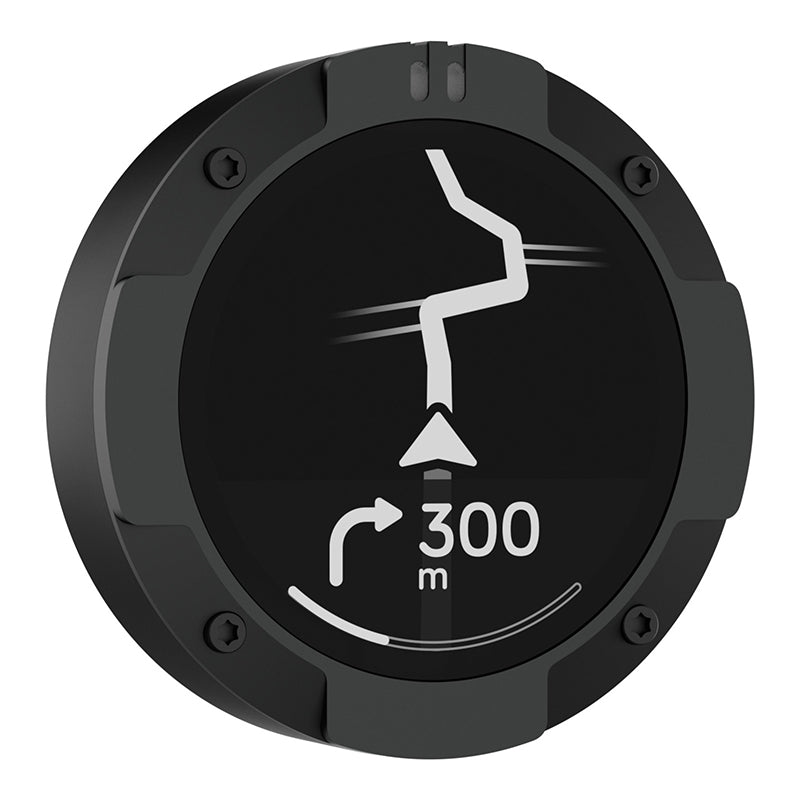
The Beeline Moto II (~AUD $379.95) is the standout at this price. Its compact arrow-based display (approximately 2 inches) shows direction rather than a full map — something many riders find less distracting at speed. It is IP67 rated (fully dustproof and waterproof to 1 metre), offers up to 14 hours of battery life, and pairs with a free smartphone app for route planning and GPX import. It is one of the few motorcycle GPS units with meaningful standalone battery life — most others must run off the bike's power supply.
The limitations are real: you still need your phone nearby for route recalculation, and the arrow-only display is not well-suited to complex junctions or unfamiliar urban areas.
Mid-Range — $650 to $750
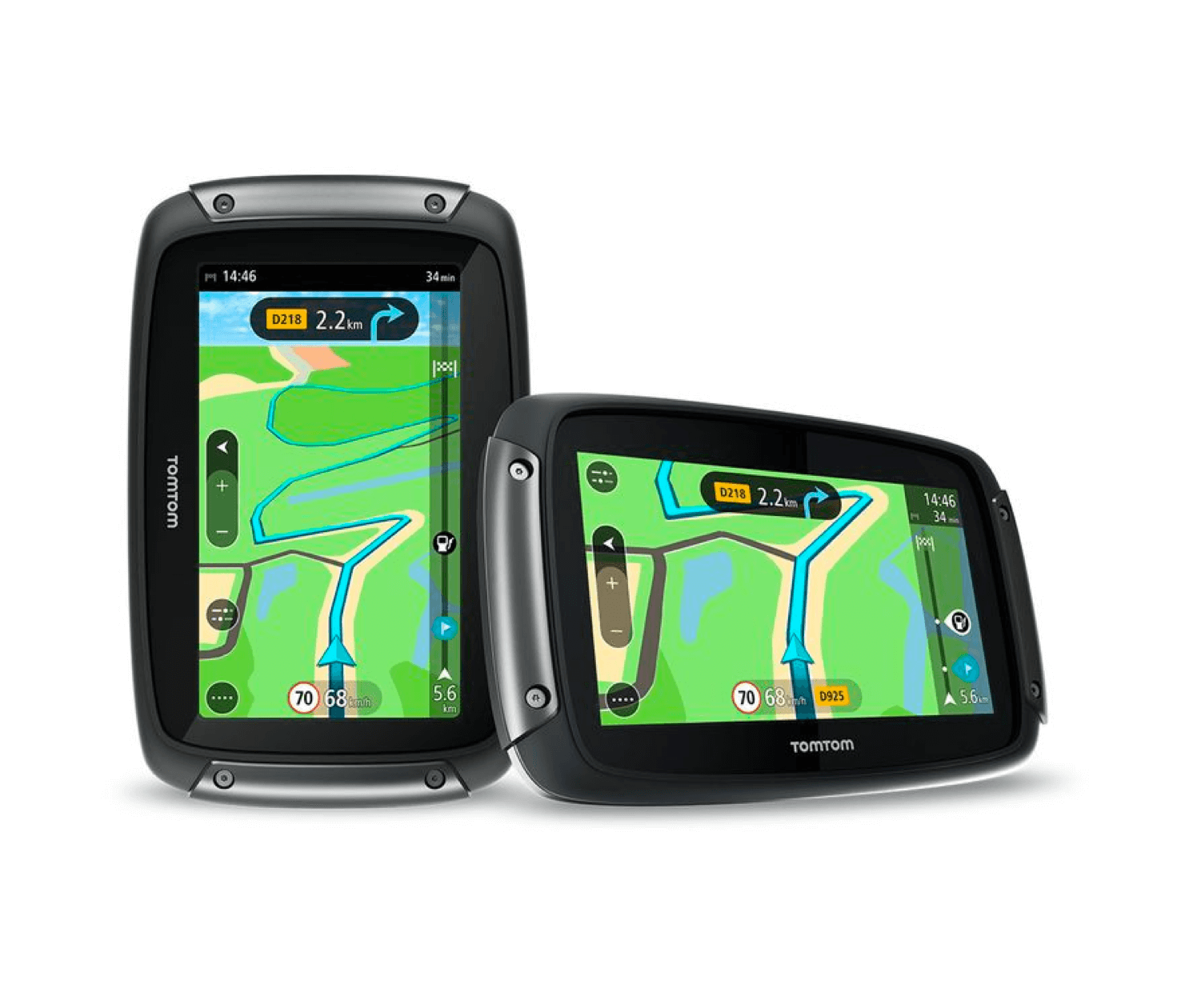
The TomTom Rider 550 (~AUD $690) is a capable 4.3-inch dedicated unit with a glove-friendly touchscreen, IPX7 water-resistance, Bluetooth, and Wi-Fi. Its routing algorithm is specifically tuned to prefer winding and hilly roads — a meaningful feature for riders who enjoy twisty tarmac over the fastest route. The MyDrive app lets you plan routes on a computer or phone and sync them wirelessly.
If you want a larger screen and are comfortable relying on your phone for navigation, the Carpuride W702 Pro is a 7-inch IP67 CarPlay/Android Auto display that runs on USB power without hardwiring. It has no onboard maps but mirrors Google Maps, Waze, or Apple Maps wirelessly at 5 GHz. This suits urban and regional riders who always have mobile data available.
Premium — $850 to $1,100
Garmin Zumo XT3 (AUD $849 for 4.7-inch / $999 for 6-inch): Garmin's 2026 flagship. IPX7-rated and certified to the MIL-STD-810 military drop standard. Beyond navigation it adds real-time lean angle monitoring, 0–100 km/h timing, eighth-mile and quarter-mile drag timing, and lap timers — useful if you also do track days. Preloaded Australia/New Zealand street and topographic maps are included. An optional Outdoor Maps+ subscription (AUD $17/month or $170/year) adds Adventure Roads and Trails content. It connects to the Garmin Tread app for group ride tracking and pairs with Bluetooth intercoms (Sena, Cardo) so navigation prompts play through your helmet.
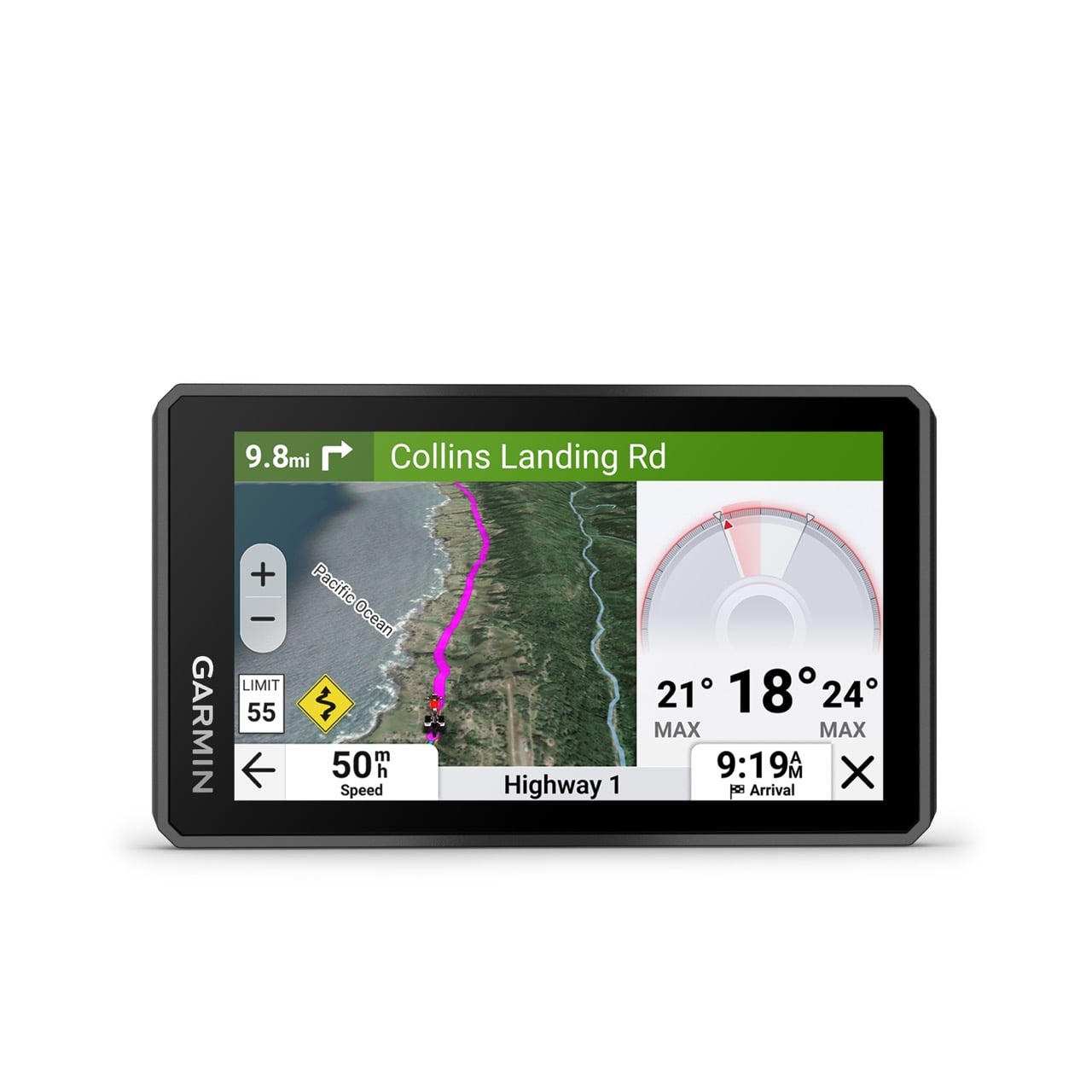
Garmin Zumo XT2 (AUD $848–$969 depending on retailer): the previous flagship, still widely available. It shares the 6-inch HD glove-friendly screen and IPX7 rating. A solid choice if the XT3's performance-recording features are not relevant to your riding.
Garmin Zumo R1 Radar (~AUD $1,044): adds integrated rear radar with blind-spot and collision warnings — the only unit in the Garmin motorcycle lineup with this feature.
Hema Maps HX-M1 (AUD $999.95): purpose-built for Australian exploration. Its 6.2-inch sunlight-readable IPS display runs offline preloaded Hema Maps covering Australia and New Zealand — 75 million kilometres of roads and tracks, and over 1.8 million points of interest including campsites, fuel stops, and caravan parks. It also includes front and rear HD dashcam recording, a physical handlebar controller (useful with gloves on), quarterly map updates via Wi-Fi, and a 3-year limited warranty. For remote Australian touring, this is the most content-rich option available.

Features That Matter
Waterproofing Ratings
- IPX7: protected against immersion to 1 m for 30 minutes. No dust-resistance rating.
- IP67: full dustproofing plus IPX7 water protection — what most road riders need.
- IP68: prolonged immersion beyond 1 m.
- IP69K: withstands high-pressure, high-temperature water jets — relevant if you regularly pressure-wash your bike after muddy rides.
Screen Brightness
Australian sun can wash out a screen quickly. Aim for at least 1,000 nits for adequate daytime readability. Higher-end units such as the Chigee AIO-6 LTE offer up to 2,000 nits.
Offline Maps and Remote Riding
Dedicated GPS units work fully offline — critical for remote outback and alpine riding where mobile coverage disappears. CarPlay/Android Auto units and phone mounts lose real-time traffic and may have degraded map performance without a data signal. Cached offline maps in apps like Google Maps partially compensate but not reliably over long remote stretches.
If you ride anywhere outside mobile coverage, a dedicated unit with preloaded maps is essential.
GPX Route Import
GPX import lets you load routes planned in apps like Scenic, Rever, or Calimoto directly onto your device. The Garmin Zumo series, Hema HX-M1, and Trail Tech Voyager Pro all support GPX, KML, and KMZ formats.
Preloaded Australian Maps
Always confirm whether AU/NZ maps are included or must be purchased separately. The Garmin Zumo XT3, TomTom Rider 550 (World Maps edition), and Hema HX-M1 all include them out of the box.
Off-Road Riders

The Trail Tech Voyager Pro is built for trail and enduro use. Its 4-inch IP67 touchscreen is paired with a Buddy Tracker feature that shows the real-time location of up to 20 riders via a mesh network — no mobile data required. This is genuinely useful for group trail riding in areas with no coverage. Note that it does not offer turn-by-turn road navigation, so it is not a substitute for a road touring unit.
Screen Size
| Screen Size | Best For |
|---|---|
| ~4 inch | Off-road — lower speeds, closer range |
| 4.7 – 5.5 inch | Road touring — good balance of readability and bulk |
| 6 – 7 inch | Highway riding — easiest glance-and-go readability; adds some handlebar weight and wind resistance |
Mounting and Power
Most dedicated GPS units run off the motorcycle's 12 V supply via a RAM mount or brand-specific cradle. Before purchasing, confirm:
- Mount compatibility with your handlebar diameter (typically 22 mm or 28 mm)
- That the mounting position does not obstruct your controls, intercom unit, or phone holder
One practical reason to choose a dedicated GPS over a phone mount: sustained engine and road vibration can damage the optical image stabilisation (OIS) sensor in smartphone cameras over time — a widely reported issue with certain models. A dedicated GPS avoids this entirely.
Australian Legal Requirements
Rules vary by state. In NSW and VIC:
- A dedicated GPS is legal for all licence holders, including learners and provisionals, provided it is secured in a fixed mount on the motorcycle and does not obstruct the rider's view.
- Learner and provisional riders may not use a mobile phone as a GPS — a dedicated GPS unit is the compliant alternative.
- The device must be set up before you ride and must not be held or touched while moving.
Check the current road rules for your specific state before riding.
Buying Checklist
Before you commit, confirm:
- AU/NZ maps preloaded — or do they cost extra?
- Waterproofing matches your riding conditions (IP67 covers most road use; IP69K for serious off-road)
- Screen brightness is adequate for Australian sun (1,000 nits minimum)
- Offline capability if you ride remote areas without mobile coverage
- GPX support if you plan and share routes digitally
- Mount fits your bars and does not conflict with existing controls